
-
5 Ridiculously Easy Ways to Reduce Your Shipping Costs
04/29/2026 — Jen Deming
In a time where managing business operating expenses is extra important, one of the first places you should look is reducing shipping costs. But analyzing your small package shipping for areas of improvement can be a time-intensive, detail-oriented process. Not everyone has the time to audit invoices and compare rates. For those who want to get the job done quickly and easily, you’re in luck: there are five quick small pack hacks that smart shippers can easily implement to help reduce costs.
- Obtain discounts with carriers
Lots of shippers don’t realize that the pricing structure you are currently using with your carrier may be negotiable, and there are different types of discounts that your account may receive. FedEx and UPS often offer discounts for new accounts when created online, but shippers beware: these discounts are usually temporary, and your pricing may fluctuate based on terms and conditions. You may lose the discounts entirely if you aren’t meeting shipping minimums and your pricing is subject to change at any time.The more you ship, the better the discounts you’re likely to receive directly from FedEx or UPS. However, even if you have a lower shipping volume, there are still ways for you to obtain discounts. If your business belongs to a trade association or a local chamber, you may have access to discounted rates through your membership. PartnerShip manages over 130 association shipping programs that offer FedEx discounts. If you’re a member of an industry group, look into your member benefits or reach out to our team to find out if you’re eligible.
Take advantage of free packaging
The packaging and supplies you need to properly contain your shipments are important, but can be costly. However that doesn’t mean you should skimp on new materials or reuse old packaging – doing so can compromise the integrity of your shipment and increase the risk of damage. The good news is, some carriers offer free shipping supplies to help ensure your package is secure. Both UPS and FedEx offer free packaging supplies for customers that you can order online and have delivered, free of charge. With free envelopes, packing tubes, boxes, and poly bags, you can be sure your small package shipment will travel safely to its final destination, all while creating some space in your shipping budget.
Make the most of Multiweight and Hundredweight options
From insurance plans to your cable bill, everyone knows you can save money from bundling. That same principal can also apply to your shipping. Both FedEx and UPS offer options for customers who are shipping multiple packages to the same location that can help you save money versus the rates you would pay if they’re considered individual packages. For businesses shipping frequently to the same locations, FedEx multiweight pricing is an efficient and cost-effective service option.
There is a catch for shippers interested in these options — it isn’t available to just any business. FedEx Multiweight must be negotiated into your contract, or offered as a part of comprehensive shipping program, like the association programs managed by PartnerShip.
Avoid dimensional weight pricing
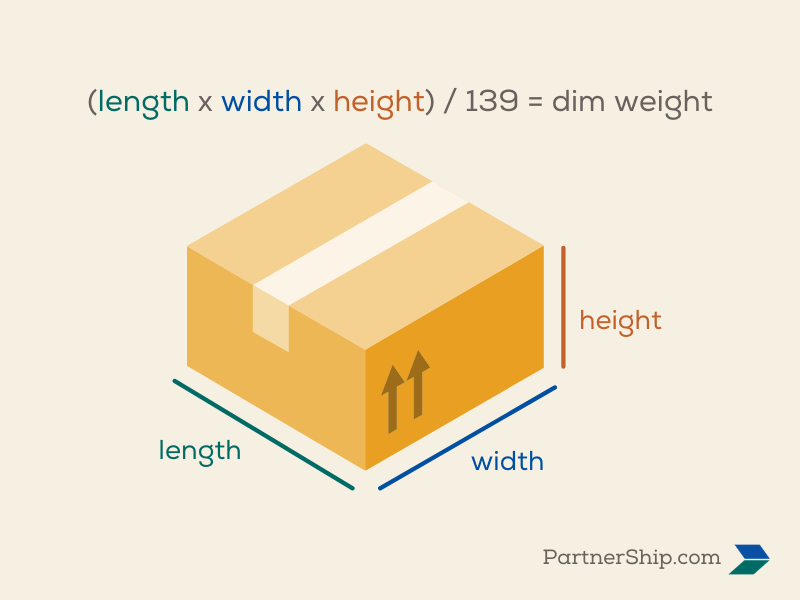
To combat the increase in bulky packages entering their systems, FedEx and UPS have implemented dimensional (DIM) weight pricing. With DIM weight pricing, cost is calculated based on package volume, rather than weight. The higher the volume, the more space it takes up in delivery vehicles, which means there is less room for other packages. If a package isn’t particularly heavy but is taking up a lot of space, that’s costly for the carriers.
After calculating your DIM weight, measure the result against your package’s actual weight; the greater of the two will become your billable weight. The best way that you can offset volume-based pricing is to take a hard look at your current packaging procedures. Unused space is a cost-conscious shipper’s worst enemy, so don’t use a package that’s oversized for the product inside and consolidate your orders when possible to ensure you’re not wasting space.
Take control of inbound shipping
Another way to save on small package shipping is by taking control of your inbound shipping procedures. It’s common practice for many businesses to allow their inbound small package orders to be arranged by the vendor. But often times that leads to higher order costs for you. By instructing your vendor to ship through your account, you can reduce your costs through a few simple steps:
- Review your vendor invoices to determine whether you have access to better pricing through your FedEx/UPS account vs. your vendor’s account.
- Create routing instructions that include clear directions on which carrier, account, and service to use for your shipments.
- Ensure vendor compliance by providing your routing instructions to your vendors and regularly reviewing your invoices for accurate pricing.
While taking an in-depth look at how to minimize operating expenses can be time-consuming, these small package hacks give you a few quick ways to ship smarter. For more ways to save, PartnerShip can help.
Click to read more... - Obtain discounts with carriers
-
Your Essential Guide to the 2026 FedEx and UPS Rate Increases
04/07/2026 — Leah Palnik

Shipping in 2026 is about to get more expensive. FedEx and UPS are both increasing their rates by an average of 5.9%. But don’t let that number fool you — your actual costs will likely climb even higher. With UPS leading the charge on December 22, and FedEx following two weeks later, these increases will have a significant impact for shippers. The real challenge lies in the hidden complexities behind the changes. It’s essential to understand them so you know how your costs will be affected and what you can do about it.
Here's your guide to the FedEx and UPS rate increases for 2026. Jump to:
- A look back at the FedEx and UPS GRIs
- Important changes for 2026
- How the FedEx and UPS rate changes will affect your costs in 2026
- What you can do to mitigate the effects of the FedEx and UPS rate increases
A look back at the FedEx and UPS GRIs
FedEx and UPS have a long history of mirroring each other’s pricing. They typically announce the same general rate increase (GRI) and have very similar pricing strategies. Bottom line, the published rates aren’t a major differentiator between the two carriers.This marks the third consecutive year that both carriers have announced an average increase of 5.9% — a level first introduced in 2022 after several years of 4.9% hikes. In 2023, rates climbed even higher to 6.9%, coinciding with a surge in shipping demand fueled by pandemic-driven e-commerce growth. The return to a 5.9% increase in 2024, 2025, and now 2026 shows that while demand has stabilized, the carriers continue to adjust pricing to offset expenses and network investments.
Some important quick facts about the new FedEx and UPS rates:
- The new FedEx rates take effect on January 5, 2026, while the UPS rates take effect two weeks earlier on December 22, 2025. Notably, UPS is raising its rates sooner, capturing more shipments moving through the end of peak season.
- The 5.9% average doesn’t take surcharges into account — many of which are increasing by more than 5.9%. When you are reviewing your shipping costs, its essential to budget for increases to surcharges as well.
- How much your costs actually go up in 2026 will be closer to 8-12% and will depend on several different factors. The services you use, the surcharges applied, your shipment dimensions and weight, and how far your shipments are traveling all have an effect.
Important changes for 2026
So you already understand that FedEx and UPS rates are going up in the new year. What does that look like exactly? First, you'll want to review the released service guide previews:If all of those numbers, tables, and fine print have you overwhelmed, you're not alone. But there are some key takeaways:
- The minimum charge for both carriers is increasing from $11.32 to $11.99. If you have discounts on your account, this heads-up is for you. Even if your discount would bring you to a base rate that's lower, you're stuck paying the minimum of $11.99 instead.
- UPS is changing the list of zip codes for the Delivery Area Surcharge, following the mid-year adjustment FedEx made to its list in June. Depending on where you’re shipping, you could get hit with a Delivery Area Surcharge on a shipment that it didn’t apply to in the past. On top of that, UPS will be changing the list of zip codes aligned to certain zones. This means that your shipments could be rated based on a more expensive zone. It’s changes like these that can make budgeting for your annual cost increase very challenging.
- The surcharges for Additional Handling and Oversized/Large Packages will now apply to more shipments than before, thanks to changes to the criteria. Starting in January, these fees will be triggered not just by length and girth, but now also by cubic volume. The shape and volume of your package, rather than just its longest sides, will now determine if you get hit with these surcharges.
- Fees for larger, more difficult-to-move packages continue to rise to hefty prices. These fees are already very costly, and in 2026 they're rising higher than the announced average. A fee for an oversized, large package could cost you up to $331 - an increase of over 8%.
- Many other common surcharges are increasing by more than the 5.9% GRI, including Delivery Area and Residential surcharges.
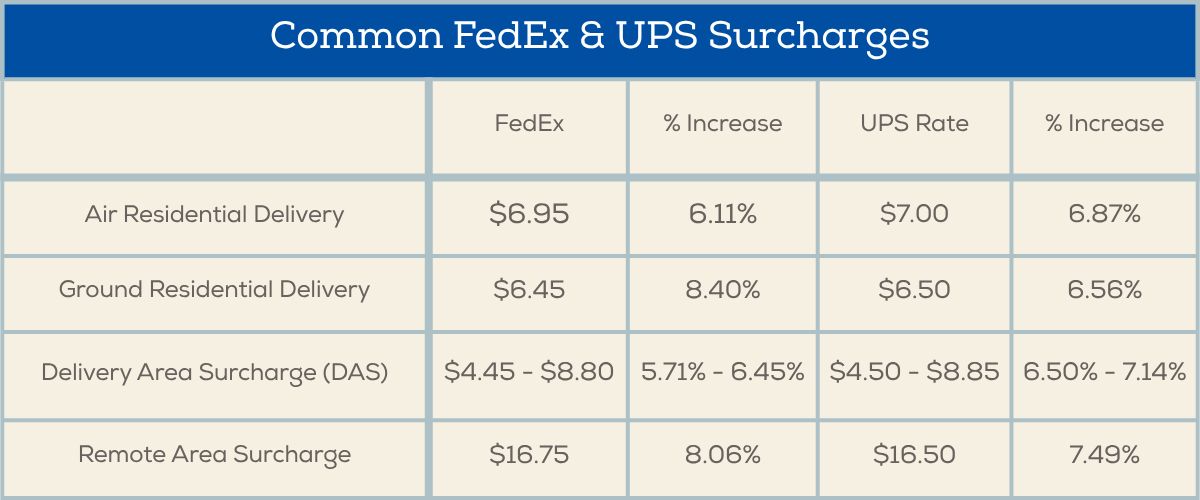
How the FedEx and UPS rate changes will affect your costs in 2026
You can’t take the announcement of a 5.9% increase at face value, unfortunately. You’ll need to determine which services you use the most, how far your shipments travel on average, and how much of your invoice charges can be attributed to fees.Most shippers will see their costs go up over the announced 5.9% average. With that in mind, let’s look at a few factors that could put you at risk for higher-than-average cost increases:
- If you’re shipping larger packages or your packages require special handling. For the past several years, FedEx and UPS have been raising these fees at an alarming rate. And in 2026 these fees will apply to more shipments than before. Any shipment they can’t run through their normal systems costs them more time and money, and these fees are a way to discourage those types of shipments from entering their networks.
- If you’re an e-commerce business. The cost of delivering packages directly to consumers continues to rise at rates that are higher than the average. Between high increases on two-day Express/Air services and increases to residential surcharges, e-commerce businesses will continue to get squeezed.
- If you ship a lot of low-density packages. This is no different than the past several years but is important nonetheless. The pricing structure that FedEx and UPS have in place dissuades larger, lighter shipments. The carriers prefer denser packages that take up less space because they’re able to fit more packages on their delivery vehicles. If your package dimensions cause your shipment to be rated at a higher weight due to dimensional (DIM) weight pricing, your cost increase could be compounded.
What you can do to mitigate the effects of the FedEx and UPS rate increases
- Right-size your packaging. While FedEx and UPS rates are based on weight, that’s not actually the whole story. If your dimensional weight is higher than the actual weight, your package will be rated using the dimensional weight - meaning you’ll be paying more. This makes any excess space within your package extra costly. Focus on packaging that allows space for the items you’re shipping and the necessary cushioning and nothing more.
- Consider opening or using a new distribution center. Shipments with the longest distance to travel cost you the most in general. Getting closer to your customers could be a great strategy for keeping those costs down.
- Evaluate the services you’re using. Ground services are the more economical option, and often the transit times are comparable to what you can get with some Express/Air services. Where you can, utilize Ground services to save on your costs.
- Take advantage of the discounts available to you. PartnerShip offers extremely competitive parcel rates that help businesses reduce shipping costs by an average of 20%. Request a quick rate comparison to see how your current pricing stacks up and where you can start saving.
Wrapping your head around all of the changes for 2026 FedEx and UPS rates can be challenging. But, using this guide to understand what's behind the announced average and published service guides is a good first step. Use this information to properly budget for the new year and set up any mitigation tactics that work best for your business.

Click to read more...
-
5 Ridiculously Easy Ways to Reduce Your Shipping Costs
04/29/2026 — Jen Deming
Click to read more... -
Your Essential Guide to the 2026 FedEx and UPS Rate Increases
04/07/2026 — Leah Palnik
Click to read more...